
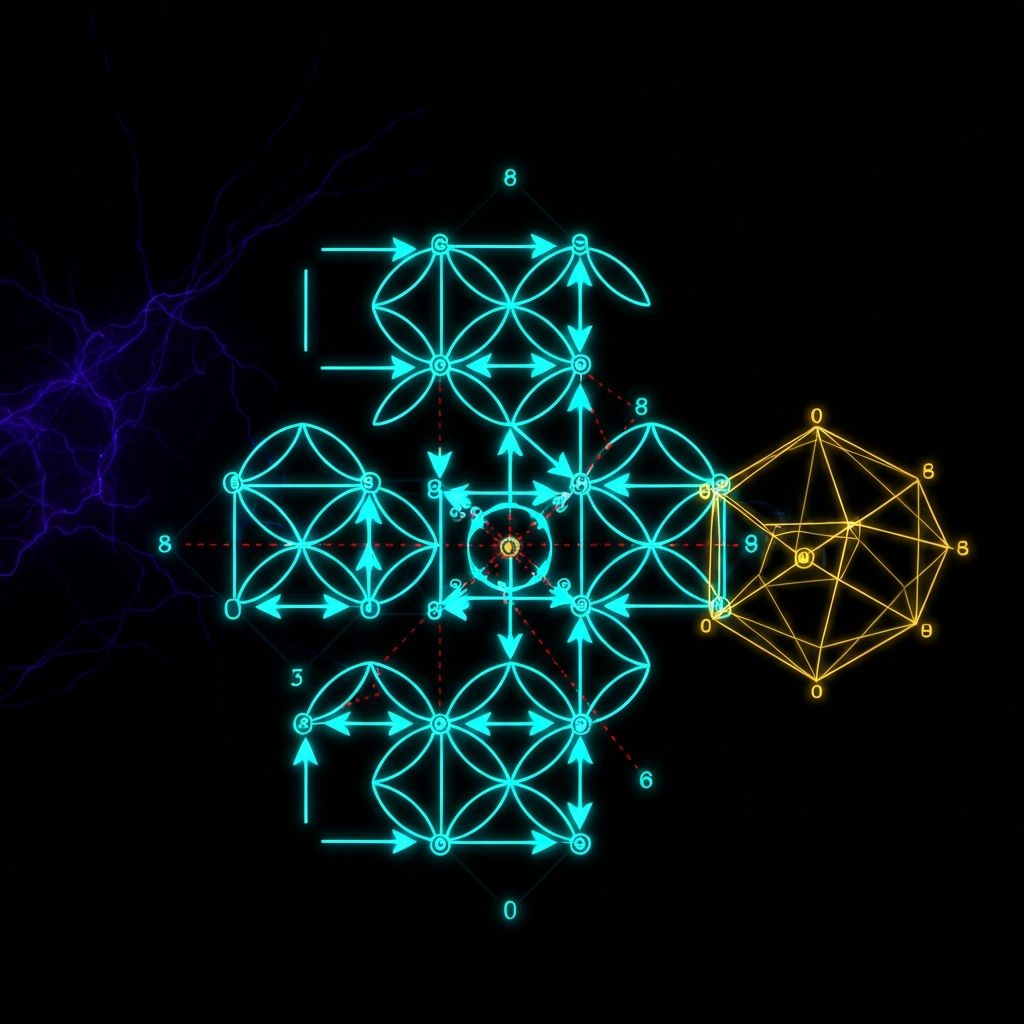
How the D8×Z2 TEN² module and D6×Z2 Seed module achieve minimal faithful permutation representations with a unique central-product conjugation property — verified by exhaustive GAP computation.
Introduction: Constrained Minimal Degree
The minimal degree μ(G) of a finite group G is the smallest n such that G embeds faithfully in Sₙ, the symmetric group on n points. This classical invariant has been studied since Johnson (1971), with refined results for direct products by Wright (1975) and comprehensive classification by Easdown–Praeger (1988).
This paper introduces a refinement: the constrained minimal degree μ(G | P), the smallest n at which a faithful G-action satisfies a given algebraic property P. The property studied here involves disjoint transpositions in Sₙ that are cyclically conjugated by a group element, with their product constrained to lie in the center Z(G). This is called the central-product property.
The TEN² Module: D₈ × Z₂ on 10 Points
The TEN² module is built on the digit set X = {0, 1, ..., 9} with two generators:
- L = (2 3 4 6 5 8 7 9) — an 8-cycle acting on R = {2,...,9}, fixing M = {0,1}
- s = (3 9)(4 7)(6 8) — a reflection satisfying sLs = L⁻¹
- C = (0 1) — a transposition acting on the membrane M
Together, G = ⟨L, s, C⟩ ≅ D₈ × Z₂ with |G| = 32, acting faithfully on all 10 points.
The fourth power L⁴ = (2 5)(3 8)(4 7)(6 9) is a product of four disjoint transpositions partitioning R into four antipodal pairs. These pairs can be canonically ordered by the quadratic moment I(a, b) = a² + b², which yields distinct values 29, 65, 73, 117 — a canonical labeling rooted in Gaussian integer norms.
Theorem (TEN² Uniqueness): The TEN² module is the unique faithful permutation representation of D₈ × Z₂ on n ≤ 10 points, up to conjugacy in Sₙ. It occurs only at n = 10. Verified by exhaustive GAP enumeration.
The Seed Module: D₆ × Z₂ on 8 Points
The Seed module operates on Y = {0,1} ∪ {2,3,4,5,6,9} (8 elements) with generators:
- L' = (2 4 5 6 9 3) — a 6-cycle on the hexagonal orbit
- s' = (3 4)(5 9) — a reflection with s'L's' = (L')⁻¹
- C = (0 1) — the same membrane transposition
H = ⟨L', s', C⟩ ≅ D₆ × Z₂, |H| = 24, acting faithfully on 8 points. The key derived elements are (L')² = (2 5 9)(3 4 6) and δ' = (L')³ = (2 6)(3 5)(4 9).
The three disjoint transpositions τ₁ = (2 6), τ₂ = (3 5), τ₃ = (4 9) are external to H but their supports are pairwise disjoint, and (L')² cyclically conjugates them:
(L')² · τ₁ · (L')⁻² = τ₂, (L')² · τ₂ · (L')⁻² = τ₃, (L')² · τ₃ · (L')⁻² = τ₁
Their product τ₁τ₂τ₃ = δ' = (L')³ is the central involution of D₆, lying in Z(H). The central-product property is satisfied.
Theorem (Seed Minimality): Among all 43 conjugacy classes of faithful D₆ × Z₂ representations on n ≤ 10 points, external disjoint-transposition 3-conjugation with the central-product property first occurs at n = 8 with exactly one conjugacy class — the Seed module. Hence μ(D₆ × Z₂ | central-product 3-conjugation) = 8.
Internal vs. External Conjugation
A subtlety exposed by the full classification: internal 3-conjugation (where the conjugated involutions lie inside H) is universal for D₆ × Z₂ — every faithful representation on n ≤ 10 admits it. External disjoint-transposition 3-conjugation (where the transpositions lie outside H) is strictly stronger and uniquely identifies the Seed module at n = 8.
The 20-State Flower of Life Extension
The construction extends naturally to a 20-state system motivated by the Flower of Life hexagonal lattice (two shells of A₂ plus a central membrane). The 20 states decompose into four orbits: a 2-point membrane, inner 6-orbit, vertex-outer 6-orbit, and edge-outer 6-orbit.
The half-turn R³ decomposes into nine disjoint transpositions — three per layer. The order-3 element R² simultaneously and independently cycles three disjoint transpositions within each layer. The full product over all nine transpositions is R³ ∈ Z(F), satisfying the central-product property in a triple-parallel version. The symmetry group remains D₆ × Z₂ (not D₆ × D₁₂) because the three 6-element orbits have distinct adjacency degrees in the Flower contact graph.
The 3D Octahedral Extension
In three dimensions, the regular octahedron provides a positive result: its three antipodal pairs (v₁,v₄), (v₂,v₅), (v₃,v₆) along the coordinate axes are cyclically conjugated by the body-diagonal C₃ rotation, and their product is the central inversion ι ∈ Z(Oₕ). Adding a 2-point membrane gives an 8-state Oₕ × Z₂ representation satisfying the central-product property.
The cuboctahedron (first FCC shell, 12 vertices) yields a negative result: despite 72 instances of 3-conjugation and 66 of 4-conjugation, none satisfies the central-product property. The structural reason is geometric: the octahedron has exactly 3 antipodal pairs matching the order-3 cycling element, while the cuboctahedron has 6 — too many for a single order-3 element to handle disjointly.
Connection to the TEN² Framework
The TEN² module — the unique D₈ × Z₂ representation on 10 points — is not merely a mathematical curiosity. It is the algebraic spine of the TEN² computational framework: the 10-state quantum universe whose D₈ × Z₂ symmetry, Clifford algebra Cl(0,8) embedding, and connection to SO(8) triality are all consequences of this unique group-theoretic structure.
The result that this representation is unique up to conjugacy in S₁₀ means the TEN²'s symmetry structure is not a design choice but a mathematical inevitability — there is exactly one way to faithfully represent D₈ × Z₂ on 10 points. This provides deep confidence in the framework's algebraic foundations.
Open Problems
Three open problems are identified for future work:
- Does μ(D₆ × Z₂ | central-product 3-conjugation) = 8 hold unconditionally for all n, or only n ≤ 10?
- Does there exist a finite group G admitting external disjoint-transposition 4-conjugation with the central-product property? Both cuboctahedron and D₄ root system have 4-conjugation but fail the central-product condition.
- Is internal 3-conjugation universal for all faithful D₆ × Z₂ representations (not just n ≤ 10)? An algebraic proof would generalize the computational result.
Verification scripts (core_verify.py, classifycorev2.g, flower_analysis.py, sphere_packing_core.py, a3_extension.py) are available at github.com/lumenhelix/core-algebra.