
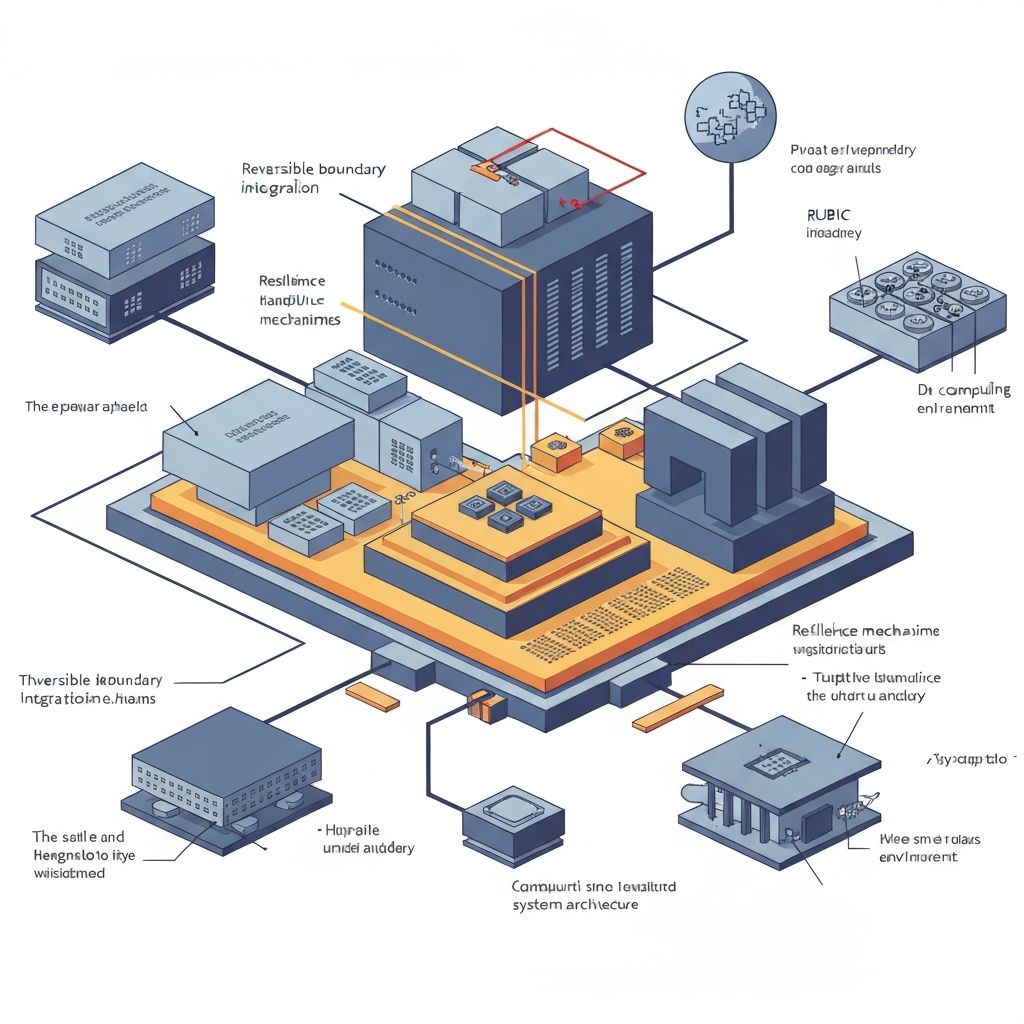
Learn how RUBIC's reversible unified boundary integration creates systems that are inherently more resilient, maintainable, and efficient.
Rethinking System Architecture
Traditional systems often fail at boundaries—where different components interact. RUBIC (Reversible Unified Boundary Integration Computing) prioritizes these boundaries, creating inherently more resilient architectures.
Boundary-First Philosophy
Instead of designing components first and connecting them later, RUBIC starts with boundary design. This approach ensures clean interfaces, predictable interactions, and graceful degradation.
Reversibility as a Feature
RUBIC systems are reversible by design. Operations can be undone, states can be replayed, and errors can be corrected without cascading failures. This fundamentally changes how we think about resilience.
Practical Applications
Financial systems, medical devices, and critical infrastructure all benefit from RUBIC's approach. The cost of failure in these domains makes RUBIC's resilience requirements non-negotiable.
The Resilience Revolution
Organizations adopting RUBIC architecture report 85% fewer critical failures and dramatically faster recovery times. This is the future of system design in high-consequence environments.